Russian Grammar: A Beginner’s Roadmap
Learn Russian grammar with a clear beginner roadmap covering cases, noun gender, verbs, word order, examples, and what to study next.

Russian grammar can feel overwhelming at first because Russian changes word endings more than English. But you do not need to learn every rule at once. The best way to make Russian grammar manageable is to follow a clear roadmap: understand the sentence, learn the six cases one by one, notice verb patterns, and then see everything again in real Russian content.
This guide gives you a beginner-friendly map of the most important Russian grammar topics. You will see what each Russian case does, how noun gender works, why verbs matter, and how to study grammar without getting stuck in endless tables.
How Russian grammar works
Russian grammar is built around word endings. In English, word order does a lot of the work. In Russian, endings often show the role of a word in the sentence.
The core idea
Russian words change form to show who is doing the action, who receives the action, where something happens, who owns something, or what someone is talking about.
The same word, книга, changes to книгу and книге because its role changes. This is the heart of Russian grammar.
One word, different roles
книга = subject or dictionary form
книгу = direct object
книге = after certain prepositions or in some indirect-object patterns
Russian cases roadmap
Russian has six main cases. Each case answers a different kind of question and gives a word a different role in the sentence.
Use this table as your roadmap. Do not memorize every ending today. First, understand what each case does, then open the dedicated guide for the case you want to study.
Roadmap tip: Learn the cases in this order: nominative, accusative, genitive, dative, instrumental, prepositional. This order makes the logic easier because each new case builds on sentence roles you have already seen.
Noun gender and agreement
Russian nouns are masculine, feminine, or neuter. Gender matters because adjectives, pronouns, and some verb forms change to match the noun.
Do not learn nouns without their gender. Instead of learning книга alone, learn книга, feminine. This makes case endings and adjective agreement much easier later.
Russian verbs and aspect
Russian verbs change for person, tense, and aspect. For beginners, the most important idea is that Russian often has two versions of a verb: one for ongoing or repeated actions, and one for completed actions.
Imperfective
Use this for ongoing, repeated, general, or unfinished actions.
Meaning: I am reading a book.
Perfective
Use this for completed actions, results, or one full action.
Meaning: I read the book.
At the beginning, do not try to master every verb pair. Learn common verbs in real sentences and notice the difference between actions in progress and completed actions.
Russian word order
Russian word order is more flexible than English because endings show the role of words. That does not mean word order is random. Neutral Russian often uses subject, verb, object, but words can move for emphasis or style.
Neutral order
Meaning: I am reading a book.
This is the most natural beginner sentence order.
Emphasis
Meaning: I am the one reading the book.
The endings still show who does what.
For now, use simple word order when you speak. When you listen and read, notice how native speakers move words to highlight information.
What to learn first
A good Russian grammar roadmap should feel progressive. You should not start with rare exceptions or long declension tables. Build the basics in this order.
Learn the alphabet well
Start with the Russian alphabet so you can notice endings without relying on transliteration.
Understand sentence roles
Learn subject, object, possession, location, direction, and receiver. These ideas make the cases easier.
Study the six cases one by one
Do not memorize all case tables at once. Use the six case guides above and focus on examples.
Add verbs and aspect
Once simple nouns and cases make sense, start noticing verb pairs and common conjugations.
Move into real content
Grammar becomes much easier when you keep seeing the same patterns in real subtitles, dialogue, and short videos.
How to make Russian grammar stick
The best way to remember Russian grammar is not to stare at case tables forever. Tables help you understand the system, but real memory comes from repeated exposure. When you hear and read enough Russian, forms like в Москве, у меня нет времени, с другом, and мне нравится start to feel natural.
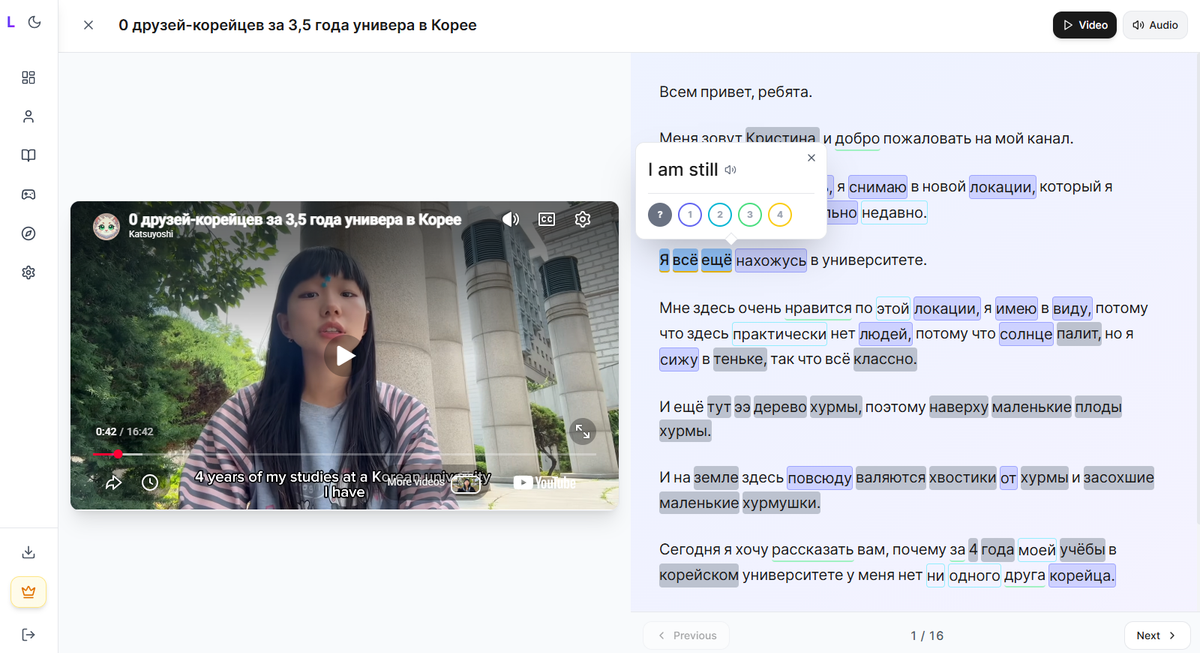
This is where Lokia can help. Instead of learning Russian grammar only as rules, you can learn from real videos, subtitles, and sentences. When you click words, hear them in context, and see them again later, the rules become easier to recognize naturally.
If you want a deeper explanation of this method, read our guide to comprehensible input. Grammar is important, but it becomes much easier when your brain has seen enough examples to make the patterns feel familiar.