Learn 100 Italian words with pronunciation, meanings, examples, and audio. Build useful vocabulary for food, travel, people, questions, and daily life.
Learning the right Italian words first makes Italian much easier to understand. Instead of memorizing random vocabulary, start with words you can reuse everywhere: greetings, food, travel, people, time, common verbs, useful adjectives, and simple question words.
This guide gives you 100 essential Italian words with pronunciation, meaning, category, examples, and audio. The goal is not to collect a long list for the sake of it. The goal is to give you a practical core vocabulary you can recognize in real conversations, menus, signs, videos, and beginner Italian sentences.
The examples are short on purpose: they show how each word behaves in a real sentence, so you can see whether it is used in greetings, restaurants, travel, questions, or everyday conversation.
Good to know: Italian pronunciation is usually more consistent than English, but sounds like c, ch, g, gn, and double consonants need attention. Listen to the examples and repeat them out loud whenever possible.
100 Italian words for beginners
Use this table as your first Italian vocabulary base. Tap the audio button next to a word or example to hear it. Start with the words you recognize immediately, then review the ones that appear often in real content.
Italian word
Pronunciation
Meaning
Example
ciao
chow
hello, bye
Ciao, come stai?Hi, how are you?
buongiorno
bwohn-jor-noh
good morning, good day
Buongiorno a tutti.Good morning everyone.
buonasera
bwoh-nah-seh-rah
good evening
Buonasera, signora.Good evening, madam.
arrivederci
ah-ree-veh-dehr-chee
goodbye
Arrivederci, a domani.Goodbye, see you tomorrow.
grazie
grah-tsyeh
thank you
Grazie mille.Thank you very much.
prego
preh-goh
you are welcome, please go ahead
Grazie. Prego!Thank you. You’re welcome!
per favore
pehr fah-voh-reh
please
Un caffè, per favore.A coffee, please.
scusa
skoo-zah
sorry, excuse me
Scusa, dov’è la stazione?Excuse me, where is the station?
sì
see
yes
Sì, va bene.Yes, that’s fine.
no
noh
no
No, grazie.No, thank you.
forse
for-seh
maybe
Forse domani.Maybe tomorrow.
bene
beh-neh
well, good
Sto bene.I’m well.
male
mah-leh
badly, bad
Non va male.It’s not bad.
oggi
ohd-jee
today
Oggi lavoro.Today I work.
domani
doh-mah-nee
tomorrow
Ci vediamo domani.See you tomorrow.
ieri
yeh-ree
yesterday
Ieri ero a Roma.Yesterday I was in Rome.
adesso
ah-dehs-soh
now
Adesso capisco.Now I understand.
sempre
sehm-preh
always
Sono sempre qui.I’m always here.
mai
mai
never, ever
Non ho mai tempo.I never have time.
qui
kwee
here
Sono qui.I’m here.
lì
lee
there
Il bagno è lì.The bathroom is there.
casa
kah-zah
house, home
Vado a casa.I’m going home.
strada
strah-dah
street, road
Questa strada è lunga.This street is long.
stazione
stah-tsyo-neh
station
Dov’è la stazione?Where is the station?
treno
treh-noh
train
Il treno è in ritardo.The train is late.
aeroporto
ah-eh-roh-por-toh
airport
Vado all’aeroporto.I’m going to the airport.
biglietto
bee-lyet-toh
ticket
Vorrei un biglietto.I would like a ticket.
hotel
oh-tehl
hotel
L’hotel è vicino.The hotel is nearby.
ristorante
rees-toh-rahn-teh
restaurant
Cerco un ristorante.I’m looking for a restaurant.
caffè
kahf-feh
coffee, café
Prendo un caffè.I’ll have a coffee.
acqua
ahk-kwah
water
Acqua naturale, per favore.Still water, please.
pane
pah-neh
bread
Il pane è fresco.The bread is fresh.
pasta
pahs-tah
pasta
Mi piace la pasta.I like pasta.
pizza
peet-tsah
pizza
Prendiamo una pizza.Let’s get a pizza.
vino
vee-noh
wine
Un bicchiere di vino.A glass of wine.
conto
kohn-toh
bill, check
Il conto, per favore.The bill, please.
menù
meh-noo
menu
Posso vedere il menù?Can I see the menu?
colazione
koh-lah-tsyo-neh
breakfast
La colazione è pronta.Breakfast is ready.
pranzo
prahn-zoh
lunch
Pranzo alle due.I have lunch at two.
cena
cheh-nah
dinner
La cena è buona.Dinner is good.
persona
pehr-soh-nah
person
È una brava persona.He or she is a good person.
amico
ah-mee-koh
friend
Lui è un amico.He is a friend.
amica
ah-mee-kah
female friend
Lei è una mia amica.She is a friend of mine.
famiglia
fah-mee-lyah
family
La mia famiglia è grande.My family is big.
madre
mah-dreh
mother
Mia madre è italiana.My mother is Italian.
padre
pah-dreh
father
Mio padre lavora.My father works.
figlio
fee-lyoh
son
Ho un figlio.I have a son.
figlia
fee-lyah
daughter
Ho una figlia.I have a daughter.
ragazzo
rah-gaht-tsoh
boy, boyfriend
Il ragazzo parla italiano.The boy speaks Italian.
ragazza
rah-gaht-tsah
girl, girlfriend
La ragazza studia.The girl studies.
uomo
woh-moh
man
Un uomo gentile.A kind man.
donna
dohn-nah
woman
Una donna italiana.An Italian woman.
bambino
bahm-bee-noh
child, boy
Il bambino dorme.The child is sleeping.
tempo
tehm-poh
time, weather
Non ho tempo.I don’t have time.
giorno
jor-noh
day
Buon giorno!Good day!
settimana
set-tee-mah-nah
week
Questa settimana studio.This week I study.
mese
meh-zeh
month
Un mese fa.A month ago.
anno
ahn-noh
year
Un anno in Italia.One year in Italy.
soldi
sohl-dee
money
Non ho soldi.I don’t have money.
prezzo
pret-tsoh
price
Qual è il prezzo?What is the price?
negozio
neh-goh-tsyo
shop, store
Il negozio è aperto.The shop is open.
mercato
mehr-kah-toh
market
Vado al mercato.I’m going to the market.
bagno
bahn-yoh
bathroom
Dov’è il bagno?Where is the bathroom?
aiuto
ah-yoo-toh
help
Aiuto!Help!
medico
meh-dee-koh
doctor
Ho bisogno di un medico.I need a doctor.
polizia
poh-lee-tsee-ah
police
Chiami la polizia.Call the police.
capire
kah-pee-reh
to understand
Non capisco.I don’t understand.
parlare
pahr-lah-reh
to speak
Parlo un po’ italiano.I speak a little Italian.
andare
ahn-dah-reh
to go
Vado a Roma.I’m going to Rome.
venire
veh-nee-reh
to come
Vieni con me?Are you coming with me?
fare
fah-reh
to do, to make
Che cosa fai?What are you doing?
avere
ah-veh-reh
to have
Ho fame.I’m hungry.
essere
ehs-seh-reh
to be
Sono pronto.I’m ready.
volere
voh-leh-reh
to want
Voglio un caffè.I want a coffee.
potere
poh-teh-reh
can, to be able to
Posso entrare?Can I come in?
sapere
sah-peh-reh
to know
Non lo so.I don’t know.
vedere
veh-deh-reh
to see
Vedo il mare.I see the sea.
mangiare
mahn-jah-reh
to eat
Voglio mangiare.I want to eat.
bere
beh-reh
to drink
Vorrei bere acqua.I would like to drink water.
grande
grahn-deh
big, large
Una casa grande.A big house.
piccolo
peek-koh-loh
small
Un piccolo caffè.A small coffee.
bello
behl-loh
beautiful, nice
Che bello!How nice!
buono
bwoh-noh
good, tasty
È molto buono.It’s very good.
nuovo
nwoh-voh
new
Un telefono nuovo.A new phone.
vecchio
vek-kyoh
old
Un libro vecchio.An old book.
caldo
kahl-doh
hot, warm
Fa caldo oggi.It’s hot today.
freddo
fredd-doh
cold
Fa freddo.It’s cold.
facile
fah-chee-leh
easy
È facile.It’s easy.
difficile
deef-fee-chee-leh
difficult
È difficile.It’s difficult.
molto
mohl-toh
very, much, a lot
Grazie molto.Thank you very much.
poco
poh-koh
little, not much
Parlo poco italiano.I speak little Italian.
tutto
toot-toh
everything, all
Va tutto bene.Everything is fine.
niente
nyehn-teh
nothing
Non è niente.It’s nothing.
perché
pehr-keh
why, because
Perché studi italiano?Why do you study Italian?
quando
kwahn-doh
when
Quando parti?When do you leave?
dove
doh-veh
where
Dove sei?Where are you?
quanto
kwahn-toh
how much, how many
Quanto costa?How much does it cost?
come
koh-meh
how, like
Come si dice?How do you say it?
chi
kee
who
Chi è?Who is it?
cosa
koh-zah
what, thing
Che cosa vuoi?What do you want?
quale
kwah-leh
which
Quale preferisci?Which one do you prefer?
questo
kwehs-toh
this
Questo è buono.This is good.
quello
kwehl-loh
that
Quello è caro.That is expensive.
Italian words FAQ
What are the most useful Italian words for beginners?
Some of the most useful Italian words for beginners are ciao, grazie, prego, sì, no, bene, casa, acqua, caffè, conto, and scusa.
How many Italian words should I learn first?
Start with 50 to 100 high-frequency Italian words. That is enough to recognize common greetings, basic questions, restaurant words, travel words, and simple verbs without overwhelming yourself.
Are Italian words hard to pronounce?
Many Italian words are easier to pronounce than English words because spelling is more consistent. The main challenges are double consonants, soft and hard C or G, and sounds like gn and gli.
What is the best way to memorize Italian vocabulary?
The best way is to learn words inside short sentences. Listen to the sentence, repeat it, and review it in context. This is more effective than memorizing isolated word pairs.
Should I learn Italian words or phrases first?
Learn both together. Individual words help you recognize meaning, while phrases show you how the words are actually used in real conversations.
Keep building your Italian vocabulary
These Italian words give you a useful base, but they become much easier to remember when you hear them again in real sentences, short dialogues, menus, subtitles, and everyday conversations.
If you want a more natural way to learn vocabulary, read our guide to comprehensible input. Seeing words in context helps you understand not only what they mean, but also when people actually use them.
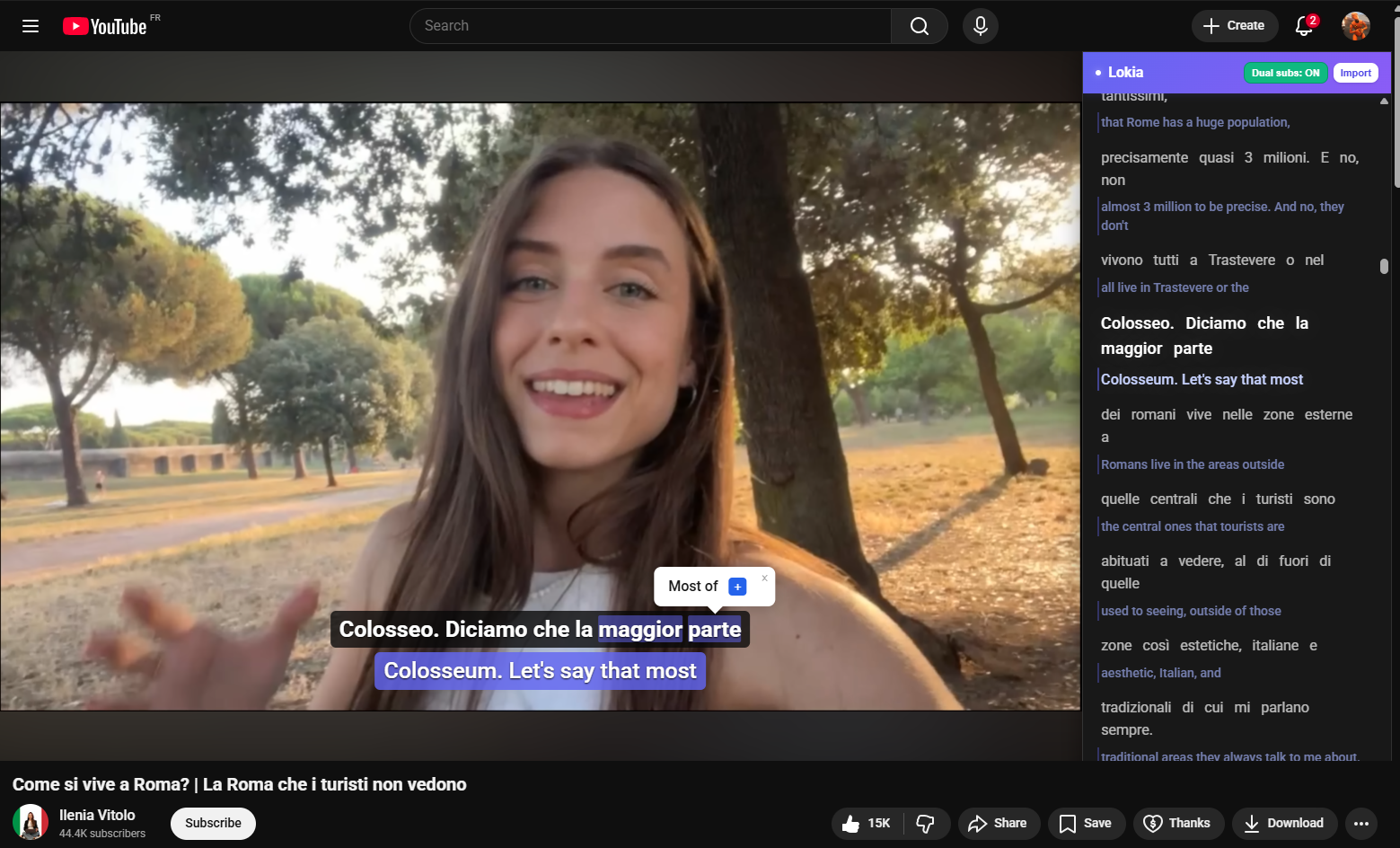
You can also use Lokia to learn Italian from real videos and subtitles. When a new word appears in a video, you can connect the sound, spelling, meaning, and situation at the same time instead of memorizing isolated translations.