Turkish Phrases: 55 Essential Expressions for Beginners
Learn 55 Turkish phrases with pronunciation, meanings, context, and audio for greetings, travel, restaurants, shopping, and emergencies.
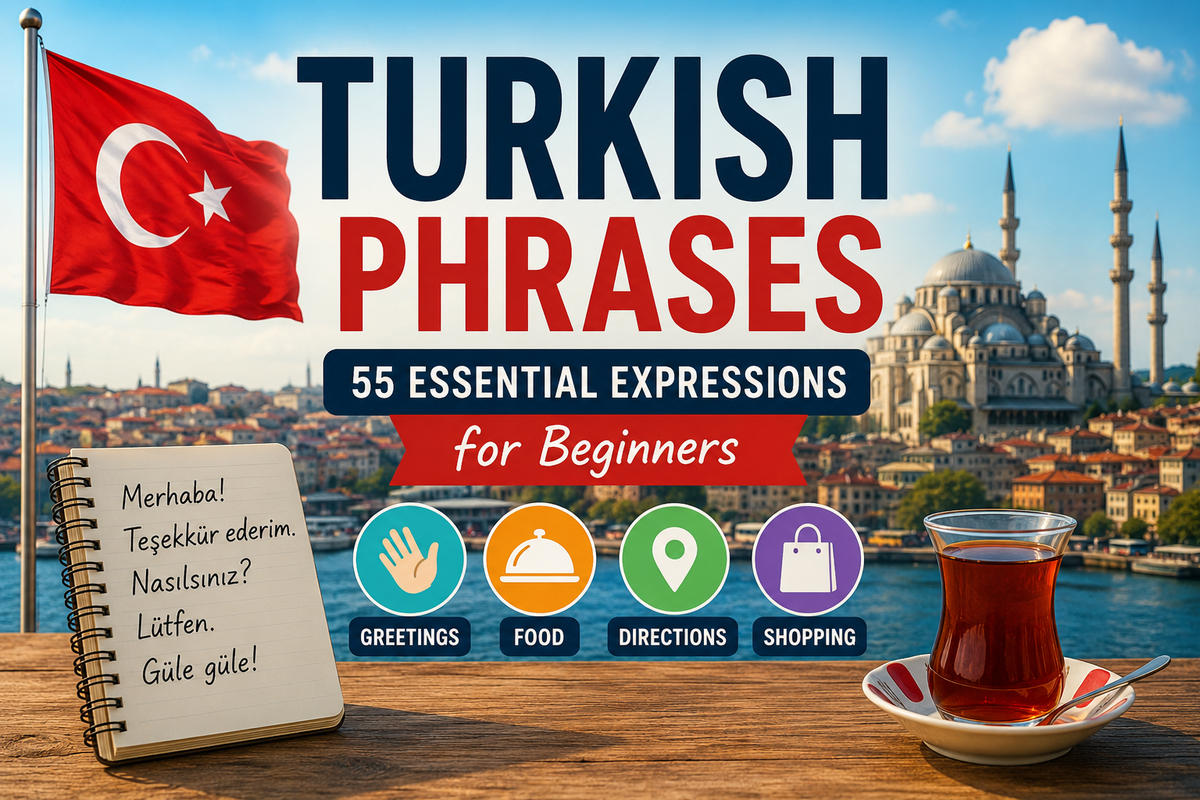
Learning a few basic Turkish phrases can make everyday situations much easier, whether you are visiting Turkey, talking to Turkish speakers, or starting your first conversations. In this guide, you will find useful phrases for greetings, restaurants, shopping, directions, polite requests, and emergencies, with pronunciation, meaning, context, and audio.
Many phrase lists give you translations but not enough context. That is a problem in Turkish because a phrase can sound polite, casual, formal, or too direct depending on the situation. This guide focuses on useful phrases you can actually say as a beginner.
If you are still getting used to Turkish letters like ç, ğ, ı, ö, ş, and ü, start with our Turkish alphabet guide first. Reading the phrases becomes much easier once the alphabet feels familiar.
Good to know: Turkish has polite and informal ways to speak. When you are not sure, choose the polite form with misiniz, musunuz, or lütfen. It is safer with strangers, staff, older people, and anyone you meet for the first time.
55 Turkish phrases for beginners
Use this table as a practical phrasebook. Tap the audio button next to a Turkish phrase to hear it. Focus first on phrases you will use often, like Merhaba, Teşekkür ederim, Ne kadar?, and Anlamıyorum.
Formal and informal Turkish phrases
Turkish often changes depending on who you are talking to. For example, Nasılsınız? is the polite form of “How are you?”, while Nasılsın? is informal. With strangers, hotel staff, restaurant staff, older people, or anyone you just met, the polite form is usually better.
The same idea appears in questions like İngilizce biliyor musunuz?, Yardım eder misiniz?, and Tekrar eder misiniz?. They sound polite because they use a respectful question form.
Simple rule: when you are not sure, use the longer phrase. In Turkish, longer often means more polite, especially with people you do not know.
Turkish phrases FAQ
What is the most common Turkish greeting?
Merhaba is the safest and most common Turkish greeting. You can use it in both casual and polite situations.
How do you say thank you in Turkish?
The standard way to say thank you is Teşekkür ederim. A shorter version is Teşekkürler. With friends, you may also hear Sağ ol.
How do you say please in Turkish?
Please in Turkish is Lütfen. You can use it when ordering food, asking for help, or making a polite request.
What should I say if I do not understand Turkish?
You can say Anlamıyorum, meaning “I do not understand”. You can also say Tekrar eder misiniz? to ask someone to repeat.
What is a useful Turkish phrase for restaurants?
Hesap lütfen means “The bill, please”. Other useful restaurant phrases include Menü alabilir miyim?, Su lütfen, and Ne önerirsiniz?.
Is Turkish pronunciation hard for beginners?
Turkish pronunciation is usually more consistent than English, but letters like ı, ğ, ö, ş, and ü need practice. Learning the Turkish alphabet first makes phrases easier to read.
Keep building your Turkish basics
Turkish phrases are useful because they let you interact before you understand every grammar rule. Start with the phrases you need most, listen carefully, and repeat them in context.
Once these phrases feel familiar, your next step is to improve pronunciation and listening. Turkish becomes much easier when you can connect each phrase with a real voice, a real situation, and a clear meaning.
Keep building your Turkish basics
Turkish phrases are useful because they let you interact before you understand every grammar rule. Start with the phrases you need most, listen carefully, and pay attention to how they are used in real situations.
This is where comprehensible input helps: you learn from Turkish that is understandable enough to follow, while still picking up new words, sounds, and sentence patterns.
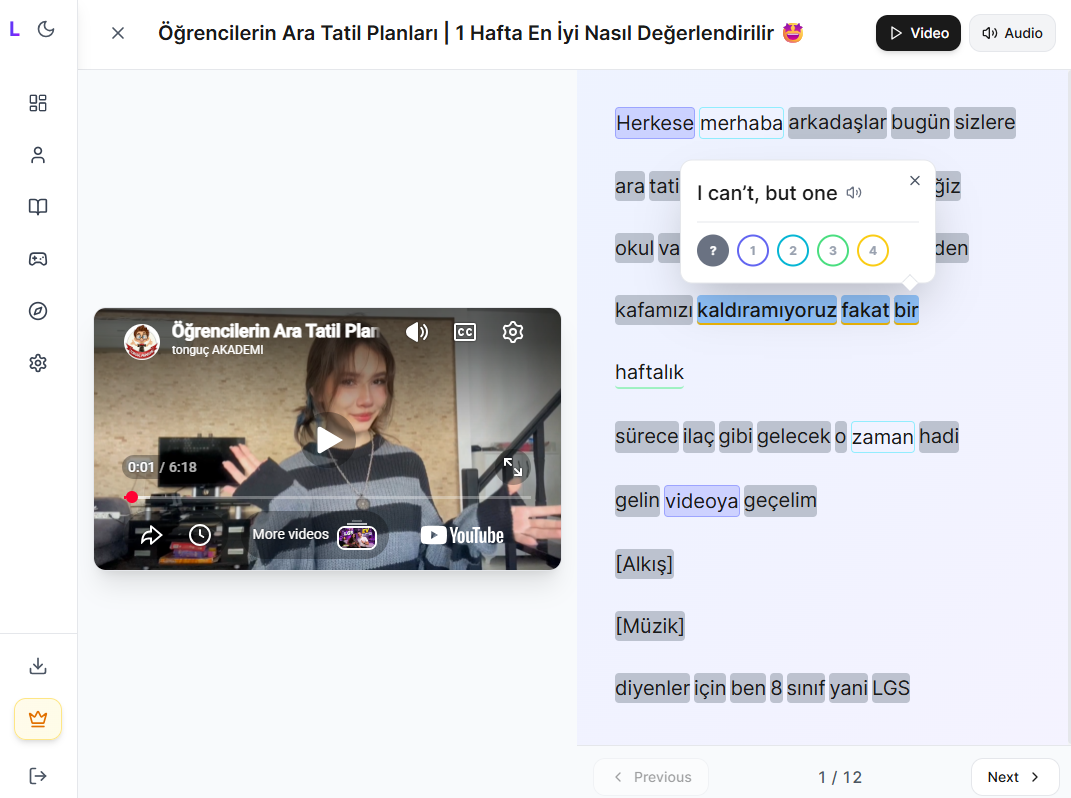
You can also use Lokia to learn Turkish from real videos and subtitles. When a phrase appears in a video, you connect the sound, spelling, meaning, and situation at the same time instead of memorizing isolated translations.