Understanding Fast Spoken French
Learn how spoken French really sounds, with common reductions, connected words, fillers, and real examples used in everyday conversations.
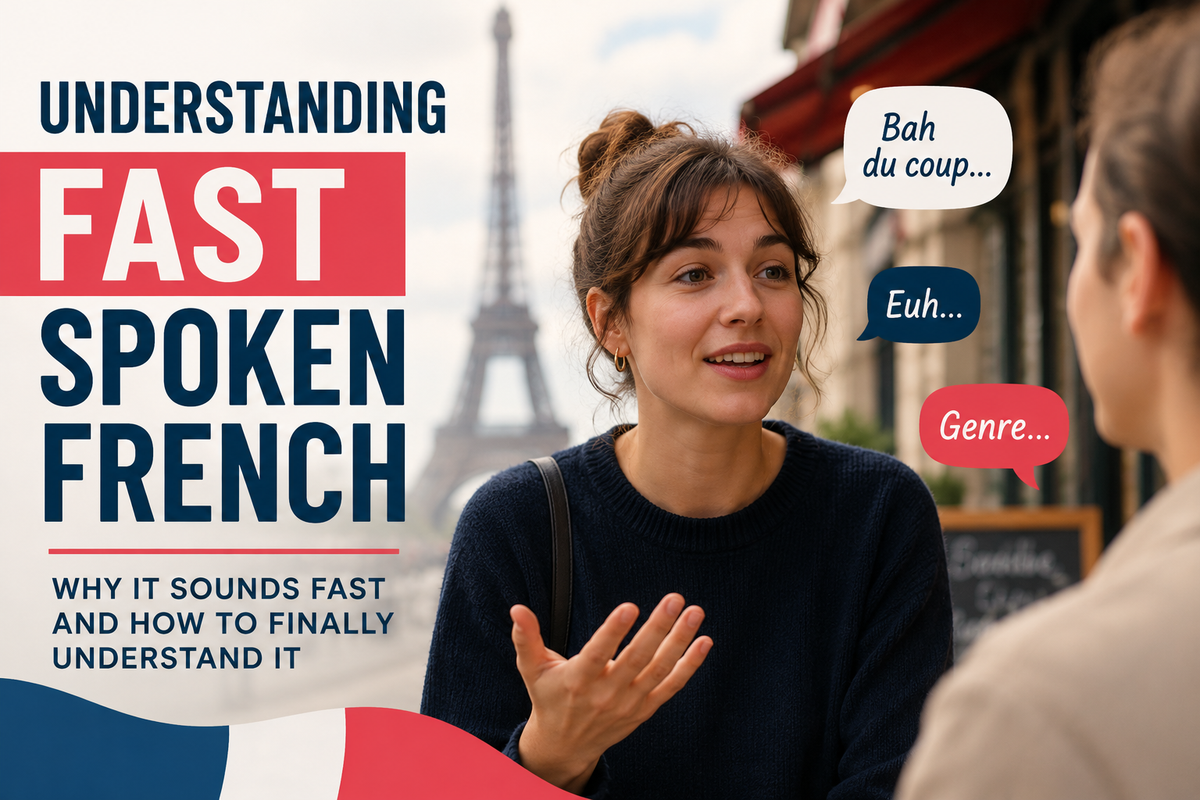
Spoken French can feel surprisingly different from the French you learn in textbooks, apps, or classroom dialogues. You may recognize the words when they are written down, but when native speakers say them naturally, the sounds often blend together, disappear, or change completely.
That is why understanding fast spoken French is such a common challenge for learners. The problem is not always speed. Most of the time, it is the gap between clear, formal French and the way French is actually spoken in everyday conversations. Once you start noticing the patterns behind real spoken French, native conversations become much easier to follow.
Spoken French Sounds Different From Written French
One of the first things learners notice is that French people rarely pronounce every word clearly in casual conversations. Spoken French is often shorter, smoother, and more relaxed than written French.
For example, in a textbook you might learn:
Je ne sais pas
I do not know
But in real spoken French, you will often hear:
Chais pas
I don’t know
This is extremely common. Native speakers are not trying to speak badly. They are simply speaking naturally.
Another example:
Il y a beaucoup de monde
There are many people
In everyday speech, this often becomes:
Y’a beaucoup d’monde
There are many people
And instead of saying:
Je suis fatigué
I am tired
Many people say:
Chuis fatigué
I’m tired
These small changes happen all the time in spoken French. If you only know the formal version, it can feel like native speakers are using different words, even when the meaning is simple.
Common Reductions in Spoken French
A big part of understanding spoken French is getting used to reductions. A reduction is when a word or group of words becomes shorter in natural speech.
Here are some of the most common ones:
Je ne sais pas → Chais pas
I don’t know
Il y a → Y’a
There is / There are
Tu es → T’es
You are
Je suis → Chuis
I am
Je ne comprends pas → J’comprends pas
I don’t understand
Tu as → T’as
You have
These reductions are not rare. You will hear them in cafés, in French YouTube videos, in podcasts, in conversations between friends, and in everyday life in France.
For learners, the hard part is that you may already know the full sentence, but not recognize the reduced version when you hear it quickly. That is why listening to real spoken French matters so much.
French Words Often Blend Together
Spoken French also feels fast because native speakers connect words together. Instead of pronouncing each word separately, they often speak in groups of sounds.
Take this sentence:
Vous avez compris ?
Did you understand?
In natural spoken French, it can sound almost like:
Vouzavé compris ?
Did you understand?
The words are still there, but they are connected. This makes the sentence smoother, but harder to separate for learners.
Another example:
Je suis allé au supermarché
I went to the supermarket
In real spoken French, this can sound more like:
Chuis allé au supermarché
I went to the supermarket
At first, your brain tries to identify every individual word. That makes listening exhausting. With enough exposure, you slowly start recognizing sound chunks instead of separate words. This is a big step toward understanding fast spoken French more naturally.
Fillers Make Spoken French Feel Faster
French speakers use a lot of fillers. These are small words and expressions that do not always add much meaning, but they are everywhere in real conversations.
Some common French fillers include:
- Bah (Well)
- Euh (Uh)
- Du coup (So / basically / as a result)
- Genre (Like)
- En fait (Actually / in fact)
- Bref (Anyway)
A sentence like this can sound confusing at first:
Bah du coup j’sais pas trop
Well, so… I’m not really sure
The meaning is simple, but the fillers make the sentence feel faster and more natural. If you are not used to hearing words like bah, du coup, or genre, spoken French can feel much harder than it really is.
You can find a full list of French filler words here.
Real Spoken French Uses Shorter Sentences
Another important thing to understand is that real French conversations are not always made of long, perfect sentences. Native speakers often use short phrases, quick reactions, and incomplete thoughts.
For example:
- Ça va ? (How are you? / Is it okay?)
- Ouais, ça va (Yeah, I’m okay)
- T’inquiète (Don’t worry)
- C’est bon (It’s fine / It’s okay)
- Vas-y (Go ahead / Come on)
- J’arrive (I’m coming)
- Attends deux secondes (Wait two seconds)
- Je vois (I see)
These sentences are simple, but native speakers say them quickly and often connect them with other words.
For example:
- Ouais vas-y, t’inquiète, j’arrive (Yeah go ahead, don’t worry, I’m coming)
This kind of sentence is very common in spoken French. It is not advanced grammar. It is everyday language said at native speed.
Textbook French vs Real Spoken French
A lot of learners feel discouraged because they compare textbook French with real spoken French and think they are not making progress. But these are almost two different listening experiences.
Textbook French is usually slow, clean, and complete.
For example:
Qu’est-ce que tu fais ce soir ?
What are you doing tonight?
In real spoken French, you may hear:
Tu fais quoi ce soir ?
What are you doing tonight?
Or even:
Tu fais quoi c’soir ?
What are you doing tonight?
The meaning is the same, but the rhythm is different.
Another example:
Est-ce que tu veux venir avec nous ?
Do you want to come with us?
In everyday spoken French, this could become:
Tu veux venir avec nous ?
Do you want to come with us?
Or casually:
Tu veux v’nir avec nous ?
Do you want to come with us?
This is why learners often understand French better when reading than when listening. The written version gives you time and clarity. Spoken French gives you rhythm, reductions, and context.
Fast Spoken French Is Not Just About Speed
When learners say “French people speak too fast”, they are usually reacting to several things at the same time.
Spoken French feels fast because words are connected, sounds are reduced, fillers appear constantly, and familiar phrases are pronounced in unexpected ways. The actual speed is only one part of the problem.
For example, this sentence may look easy:
Je ne sais pas ce que tu veux dire
I do not know what you mean
But in real spoken French, it can sound closer to:
Chais pas c’que tu veux dire
I don’t know what you mean
If you are waiting to hear every word clearly, you might miss the whole sentence. But once you recognize chais pas, c’que, and the rhythm of the phrase, it becomes much easier.
This is one of the most important shifts in French listening comprehension. You are not trying to hear perfect written French. You are learning to understand real spoken French.
Context Helps More Than You Think
When listening to native speakers, you do not need to catch every single word. Native speakers do not always process language word by word either. They use context, tone, body language, and familiar patterns.
Imagine someone is pointing at a chair and says:
Tu peux t’asseoir là
You can sit there
Even if you only hear peux, asseoir, and là, you can probably understand the message from the situation.
Or if someone looks surprised and says:
Ah bon ? Sérieux ?
Really? Seriously?
You do not need a grammar explanation. The emotion and context help you understand.
This is why visual content, short dialogues, subtitles, and repeated exposure are so useful. They make spoken French more understandable without forcing you to translate everything.
Good Listening Practice Starts With Understandable French
If you jump directly into fast podcasts, French movies, or street interviews, it can feel overwhelming. Native content is useful, but only when you can understand enough to stay connected to the meaning.
A better approach is to start with spoken French that is slightly easier than full native speed. You want content that feels challenging but not impossible.
Good listening practice can include short dialogues, videos with visual context, slow French podcasts, YouTube videos with subtitles, or simple conversations about topics you already know.
The goal is not to understand every word perfectly. The goal is to get used to the sound of spoken French while still following the general meaning.
Spoken French Becomes Easier Through Repetition
Understanding spoken French takes time because your brain needs repeated exposure to the same sounds and patterns.
The first time you hear:
Chais pas
I don’t know
it may sound strange.
After hearing it many times in different conversations, it starts to feel normal. Eventually, you do not translate it anymore. You just understand it.
The same thing happens with:
Y’a
There is / There are
T’inquiète
Don’t worry
C’est bon
It’s fine / It’s okay
Du coup
So / basically
This is one reason comprehensible input works so well for language learning. When you hear understandable French again and again, your brain naturally starts recognizing patterns.
A Simple Spoken French Example
Let’s look at a short everyday conversation.
Salut, ça va ?
Hi, how are you?
Ouais ça va, et toi ?
Yeah I’m good, and you?
Ça va. Tu fais quoi ce soir ?
I’m good. What are you doing tonight?
Chais pas encore. Peut-être j’vais voir des potes.
I don’t know yet. Maybe I’m going to see some friends.
Ah ok, bah tiens-moi au courant.
Oh okay, well keep me updated.
This conversation is not advanced, but it contains several things learners need to recognize:
- Chais pas (I don’t know)
- J’vais (I’m going to)
- Des potes (Some friends)
- Bah (Well)
- Tiens-moi au courant (Keep me updated)
This is the kind of real spoken French that helps learners move beyond textbook sentences. It is simple, natural, and useful.
Learning Spoken French With Real Content
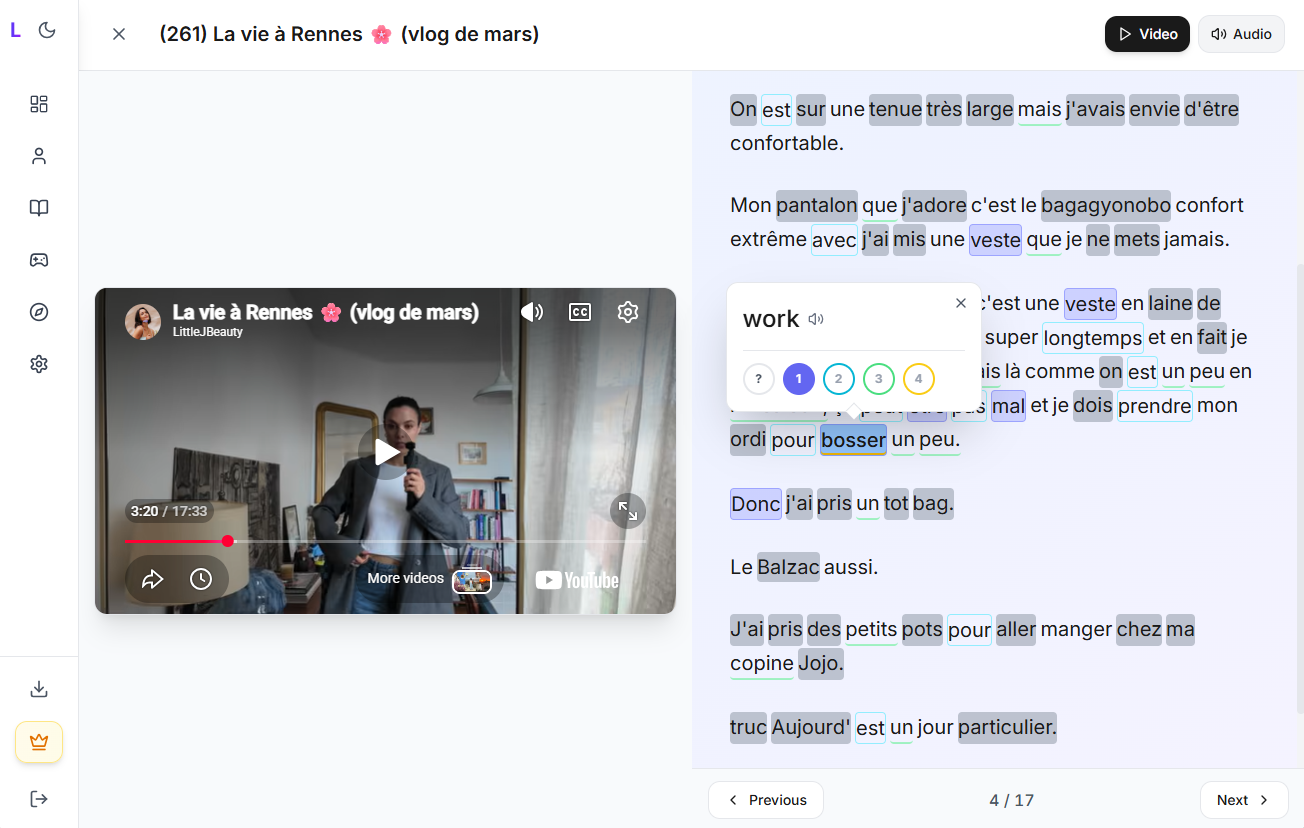
One of the best ways to improve your listening comprehension is to spend more time with real spoken French that you can actually understand. That means listening to natural sentences, common expressions, and everyday conversations in context.
This is also the idea behind Lokia.
Lokia is built around comprehensible input: helping learners spend more time with language they can understand, enjoy, and slowly absorb.
Spoken French Gets Clearer Over Time
At the beginning, spoken French often sounds like one long stream of sounds. That is normal. Your brain has not yet learned where the words begin, where they end, and which reductions native speakers use.
But with regular exposure, things start to change. You begin recognizing common expressions. Then you notice fillers. Then reductions like chais pas, y’a, and t’es become familiar. Little by little, fast French starts to feel less fast.
You are not simply training yourself to listen faster. You are training yourself to recognize spoken French the way it is actually used in real conversations.