French Filler Words: Sound More Natural When Speaking French
Learn the most common French filler words like “euh”, “du coup” and “genre”. Understand how native speakers really talk and sound more natural in French.
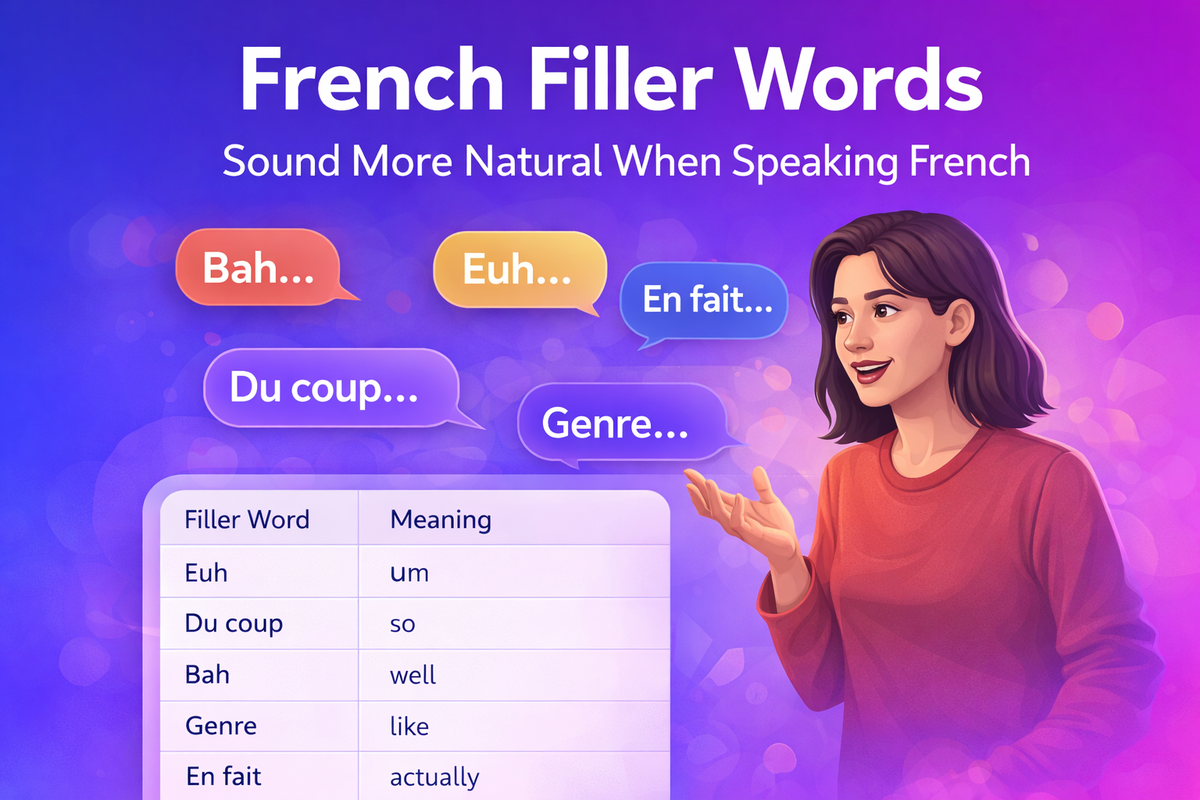
If you’ve ever listened to native French speakers, you’ve probably noticed that they don’t speak in perfectly structured sentences.
Instead, they use small words and sounds like “euh”, “du coup”, or “genre” all the time.
These are called French filler words, and they play a big role in making your speech sound natural.
What Are French Filler Words?
Filler words are small expressions that don’t add real meaning to a sentence but help you:
- Think while speaking
- Avoid awkward silence
- Sound more fluent and natural
Every language has them. In English, you hear things like “um”, “like”, or “you know”.
French is no different.
Why You Should Learn French Filler Words
Most learners focus only on grammar and vocabulary, but ignore filler words.
That’s a mistake.
Using French filler words helps you:
- Sound less robotic
- Gain time to think
- Better understand native speakers
Without them, your French may be correct, but it can feel unnatural.
Common French Filler Words
Here are some of the most used French filler words you’ll hear in everyday conversations:
1. Euh
Equivalent to “um” or “uh”
Used when thinking
Example:
Euh… je sais pas.
2. Du coup
Very common in spoken French
Used to mean “so” or “as a result”
Example:
J’étais fatigué, du coup je suis resté chez moi.
3. Genre
Similar to “like” in English
Example:
C’était genre super intéressant.
4. En fait
Means “actually” or “in fact”
Example:
En fait, je voulais dire autre chose.
5. Bah
Casual filler, similar to “well”
Example:
Bah… on peut essayer.
6. Tu vois
Means “you see”
Example:
C’est difficile, tu vois ?
7. Quoi
Often added at the end of a sentence
Example:
C’est bizarre, quoi.
When to Use (and Not Overuse) Them
While French filler words are useful, using too many can make your speech unclear.
The goal is not to fill every silence, but to:
- Use them naturally
- Understand them when listening
- Integrate them progressively
Think of them as tools, not crutches.
How to Practice French Filler Words
The best way to learn filler words is through real exposure.
Instead of memorizing them, try to:
- Listen to native speakers
- Watch videos or interviews
- Notice how often and when they are used
Over time, you’ll start using them automatically.
French filler words are a small but essential part of real communication.
They help bridge the gap between textbook French and how people actually speak.
By learning and recognizing them, you’ll not only understand more, but also sound more natural and confident when speaking French.