How to Understand Fast Spanish When Native Speakers Talk
Learn how to understand fast Spanish with practical listening techniques. Improve your Spanish listening skills and follow real conversations more easily.
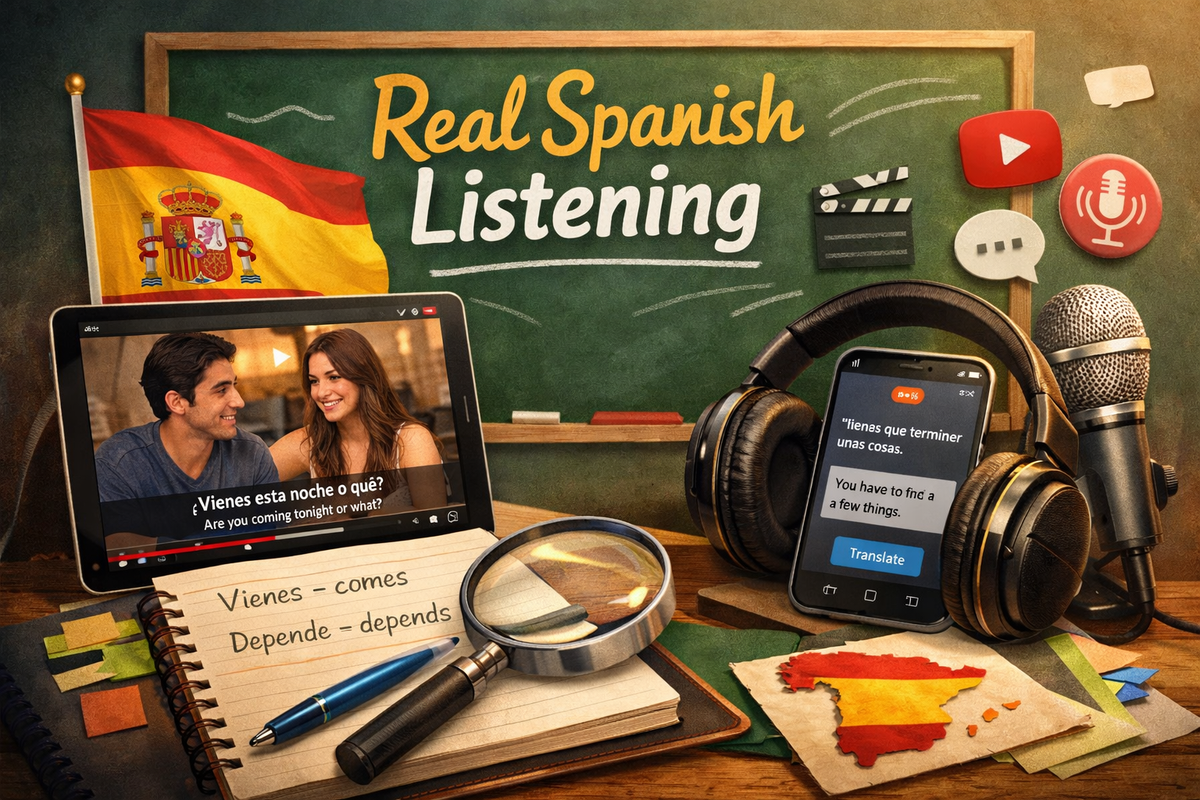
Most learners struggle to understand fast Spanish in real conversations.
They can understand Spanish when it is slow and clear. But when native speakers talk, everything sounds too fast. Words blend together, familiar words become hard to recognize, and comprehension breaks after a few seconds.
You might feel like you are missing vocabulary or that Spanish is simply too fast.
But the real issue is not that obvious.
Why you can’t understand fast Spanish
The problem is not speed.
The problem is that spoken Spanish is different from the Spanish most learners study at the beginning.
In real speech, words are connected, sounds are reduced, and pronunciation changes depending on speed, region, and context.
For example:
- para eso (“for that”) → pa eso
- está bien (“it’s fine / okay”) → ta bien
- todo el mundo (“everyone”) → to el mundo
- voy a (“I’m going to”) → voa
- ¿qué estás haciendo? (“what are you doing?”) → qué stás haciendo
These are not new words. They are familiar words in a faster and more compressed form.
Take this simple sentence:
Written Spanish:
Voy a hablar con él para eso. (“I’m going to talk to him about that”)
What many learners expect to hear:
voy / a / hablar / con / él / para / eso
What they may actually hear in fast speech:
voa hablar con él pa eso
Or this one:
Written Spanish:
Está bien, no pasa nada. (“It’s fine, nothing’s wrong / no problem”)
What you may hear:
Ta bien, no pasa na
If you only know the clear, careful version of Spanish, real conversations can feel like a different language.
Step 1: Train your ear with slower Spanish first
If you start with very fast native Spanish, your brain cannot process enough information to learn from it.
You need audio that is still natural, but slow enough for you to follow most of it.
A good target is content where you understand around 70 to 80 percent.
That means you are challenged, but not overwhelmed.
For example, if you hear this sentence:
Esta mañana fui al mercado y compré frutas para la semana.
You should be able to catch most of it, even if you miss one or two words.
If instead you hear:
Esta mañana fui al mercado y compré frutas para la semana, pero luego pasé por la casa de mi hermana porque teníamos que hablar de un problema familiar
and you only understand mañana, mercado and hermana, then the content is too difficult for your current level.
Start with:
- learner podcasts with clear pronunciation
- YouTube channels for intermediate Spanish learners
- videos with accurate subtitles
- short clips you can replay many times
The goal is not to understand everything immediately. The goal is to build recognition.
Step 2: Use repetition correctly
Listening once is rarely enough.
To understand fast Spanish, you need repeated contact with the same sounds and the same phrases.
Here is a practical method:
First listen without subtitles.
For example, imagine you hear:
No sé si te lo dije, pero al final no fui porque estaba cansado.
On the first listen, you may only catch:
- no sé
- al final
- no fui
- cansado
That is normal.
Then listen again with subtitles and notice what you missed:
- si te lo dije
- porque estaba
Then replay only the difficult part:
si te lo dije, pero al final no fui
By the third or fourth listen, the sentence becomes much clearer.
This is how repetition helps. It teaches your brain to connect sounds to words more quickly.
A lot of learners make the mistake of constantly switching to new content. That feels productive, but it often slows listening progress.
A better approach is to stay longer with the same audio.
Step 3: Focus on chunks, not individual words
Trying to understand every word one by one will slow you down.
Fast Spanish becomes easier when you stop listening for isolated words and start recognizing common chunks.
For example, do not train your brain to hear this:
- me
- da
- igual
Train your brain to recognize the whole chunk:
- me da igual (“I don’t care”)
That expression means “I don’t care” or “it doesn’t matter to me,” and native speakers use it as one natural unit.
More examples of useful chunks:
- no sé (“I don’t know”)
- a ver (“let’s see”)
- o sea (“I mean” / “in other words”)
- por eso (“that’s why” / “for that reason”)
- qué tal (“how’s it going?” / “how are things?”)
- tengo que (“I have to”)
- hay que (“you have to” / “it is necessary to”)
- me parece que (“it seems to me that” / “I think that”)
- no pasa nada (“no problem” / “it’s okay”)
Now look at this sentence:
No sé qué hacer, la verdad.
A beginner may try to process:
- no
- sé
- qué
- hacer
- la
- verdad
But a better way is to hear:
- no sé qué hacer (“I don’t know what to do”)
- la verdad (“honestly” / “the truth”)
Another example:
O sea, no pasa nada, pero me parece raro.
Instead of decoding each word separately, it is much easier if you already know these chunks:
- o sea (“I mean”)
- no pasa nada (“it’s fine” / “no problem”)
- me parece (“it seems to me”)
This is one of the most practical ways to understand fast Spanish more easily.
Step 4: Learn common spoken patterns
If you want to understand fast Spanish, you need to learn how Spanish changes in real speech.
This does not mean memorizing grammar rules. It means noticing patterns that appear again and again.
Some common ones are:
- para becomes pa
- está becomes ta
- nada may sound like na
- pues may sound very short or almost disappear in fast speech
- -ado endings may become softer in some accents, so cansado can sound closer to cansao
Examples in context:
- Para dónde vas (“where are you going”) → Pa dónde vas
- No pasa nada (“no problem” / “it’s fine”) → No pasa na
- Estoy cansado (“I am tired”) → Toy cansao
- ¿Qué estás haciendo? (“what are you doing?”) → ¿Qué tás haciendo?
This matters because if you only expect the textbook version, you will miss words you already know.
A useful habit is to keep a notebook or note app with two columns:
- what you read
- what you heard
For example:
- para eso → pa eso
- está bien → ta bien
- nada → na
That small habit can improve your listening much faster than passive exposure alone.
Step 5: Increase speed gradually
Many learners fail because they go from slow practice material straight into full-speed native speech.
That jump is too big.
A better progression looks like this:
- clear and slow Spanish
- natural but controlled speech
- fast native conversations
You can also control speed yourself.
For example:
- Listen to a clip at 0.75x
- Listen again at 0.9x
- Return to normal speed
Suppose the sentence is:
Te lo estaba diciendo desde hace tiempo, pero no me escuchaste.
At full speed, it may feel too dense.
At 0.75x, you can hear the structure more clearly:
- te lo estaba diciendo
- desde hace tiempo
- pero no me escuchaste
Then when you go back to normal speed, your brain already knows what to expect.
This is not cheating. It is training.
Step 6: Train daily with real content
To understand Spanish in real situations, you need regular exposure to real Spanish.
That means content made for native speakers or content that sounds close to native speech.
Good options include:
- YouTube videos
- podcasts
- interviews
- vlogs
- short scenes from series
What matters is not just the source, but how you use it.
A simple and effective session looks like this:
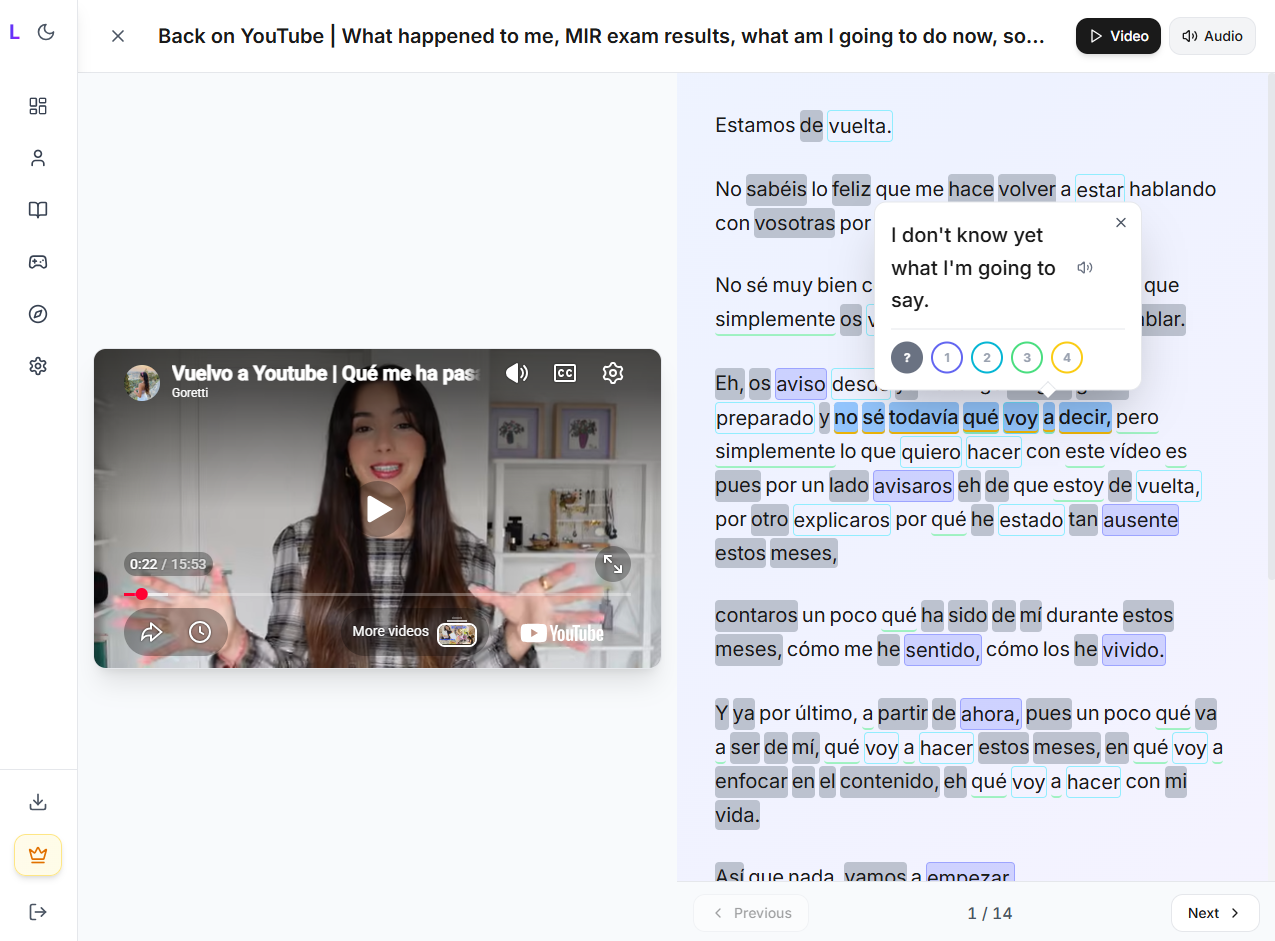
- First listen: watch the video once and try to understand the general idea.
- Second listen: watch again with subtitles.
- Translate: pause the video and translate the words and sentences you don’t understand.
- Final listen: watch the same video again without subtitles and check how much more you understand.
Tools like Lokia can help during this process by letting you translate subtitles directly on the video and replay the same content easily.
Step 7: Accept partial understanding
A lot of learners think they need to understand every word.
That is not how real listening works.
Even in your native language, you do not consciously process every single word. You follow the message.
The same applies in Spanish.
For example, imagine you hear:
Ayer fui al centro con unos amigos y luego fuimos a cenar a un sitio nuevo que abrió hace poco.
You may only catch:
- ayer (“yesterday”)
- centro (“downtown” / “city center”)
- amigos (“friends”)
- cenar (“to have dinner” / “to eat”)
- sitio nuevo (“new place”)
And that is enough to understand the main idea: someone went downtown with friends and then went to eat somewhere new.
That is real comprehension.
Another example:
No te preocupes, luego lo vemos con calma. (“Don’t worry, we’ll look at it later / we’ll deal with it later calmly.”)
Even if you miss con calma, you can still understand the main message: don’t worry, we’ll deal with it later.
If you insist on perfect understanding, you will constantly fall behind.
If you accept partial understanding, you stay with the conversation longer, and your listening improves faster.
What actually improves your ability to understand Spanish
You get better at understanding fast Spanish when your brain becomes familiar with:
- common chunks
- common reductions
- common sentence patterns
- real pronunciation
That is when Spanish starts to feel slower, even though it is not slower at all.
You are simply processing it more efficiently.
If you want to understand fast Spanish, you need more than vocabulary. You need repeated contact with real speech, real patterns, and real examples.