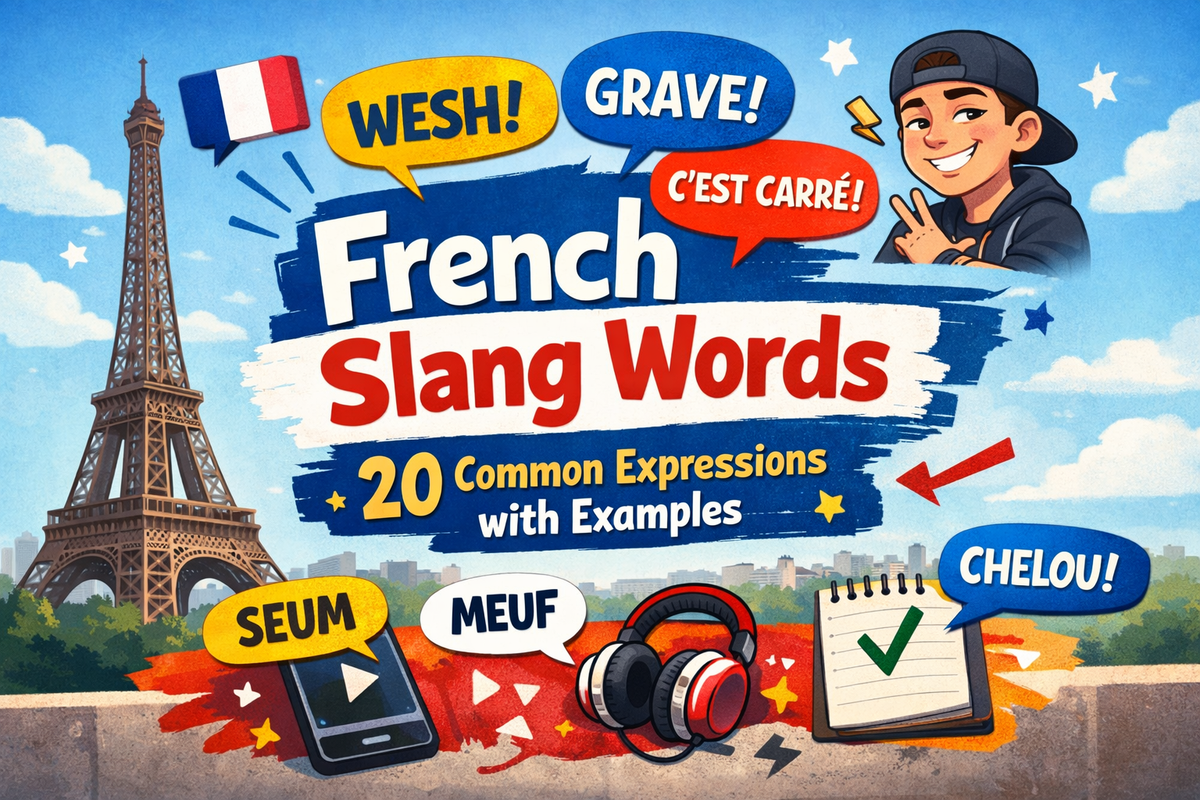
French Slang: 20 Common Words and Expressions You Will Actually Hear
Discover 20 common French slang words with meanings and real examples. Learn how native speakers actually talk in everyday French.
If you want to understand real spoken French, learning slang is essential.
French slang is everywhere in daily conversations, on YouTube, in music, and on social media. The problem is that most learners only study textbook French, then get lost the moment native speakers start talking naturally.
Here are some of the most useful French slang words and expressions to know, with simple examples.
1. Wesh
Meaning: hey, yo, what’s up, or sometimes a reaction of surprise
Examples:
Wesh, ça va ?
Hey, how are you?
Wesh, t’es déjà là ?
Wait, you’re already here?
2. C’est carré
Meaning: it’s all set, it’s good, everything is sorted
Example:
T’inquiète, j’ai réservé le resto, c’est carré.
Don’t worry, I booked the restaurant, it’s all sorted.
3. Avoir le seum
Meaning: to be upset, annoyed, disappointed
Example:
J’ai raté mon train, j’ai le seum.
I missed my train, I’m so annoyed.
4. Mec
Meaning: guy, dude
Example:
C’est qui ce mec ?
Who’s that guy?
5. Meuf
Meaning: woman, girl
Example:
La meuf là-bas est super sympa.
That girl over there is really nice.
6. Reuf
Meaning: bro, brother
Example:
Bien ou quoi, reuf ?
You good, bro?
7. Ouf
Meaning: crazy, insane, amazing depending on context
Example:
Ce concert était ouf.
That concert was insane.
8. Chelou
Meaning: weird, suspicious
Example:
Ce message est un peu chelou.
That message is kind of weird.
9. Relou
Meaning: annoying
Example:
Il est relou avec ses questions.
He’s annoying with all his questions.
10. Kiffer
Meaning: to really like, to love
Example:
Je kiffe cette chanson.
I love this song.
11. Grave
Meaning: totally, definitely
Example:
Tu viens ce soir ? Grave.
Are you coming tonight? Totally.
12. T’inquiète
Meaning: don’t worry
Example:
T’inquiète, je gère.
Don’t worry, I’ve got it.
13. Genre
Meaning: like
Example:
Il m’a regardé genre il me connaissait déjà.
He looked at me like he already knew me.
14. Du coup
Meaning: so, as a result, basically depending on context
Example:
Il pleuvait, du coup on est restés chez nous.
It was raining, so we stayed home.
15. En vrai
Meaning: honestly, actually
Example:
En vrai, ce film était pas mal.
Honestly, that movie was not bad.
16. Frérot
Meaning: bro
Example:
Merci frérot.
Thanks, bro.
17. Ça passe
Meaning: it’s okay, it works, it’ll do
Example:
On n’a plus beaucoup de temps, mais ça passe.
We don’t have much time left, but it’s okay.
18. BG
Meaning: good-looking guy, handsome, sometimes used jokingly with friends
Example:
Regarde ce BG.
Look at that handsome guy.
19. Mytho
Meaning: liar
Example:
Arrête, t’es un mytho.
Stop it, you’re such a liar.
20. Chiller
Meaning: to relax, to hang out
Example:
On va juste chiller ce soir.
We’re just going to relax tonight.
Why French Slang Is Hard to Understand
French slang is difficult because it changes the language in three ways at once.
First, some words come from verlan, a system where syllables are reversed, like meuf, ouf, reuf, and chelou. Second, common spoken French uses lots of fillers like du coup, genre, and en vrai. Third, many slang words depend heavily on tone and context, especially words like wesh. (Tandem - Speak Any Language)
How to Actually Learn French Slang
Do not memorize slang as isolated vocabulary.
The best way to learn it is through real content:
- YouTube videos
- interviews
- music
- livestreams
- casual conversations
That way, you hear the word, see the context, and understand how people really use it.
How Lokia Helps You Learn French Slang Naturally
French slang is almost never taught properly in traditional lessons. You usually discover it in real content.
That is exactly why Lokia makes sense here.
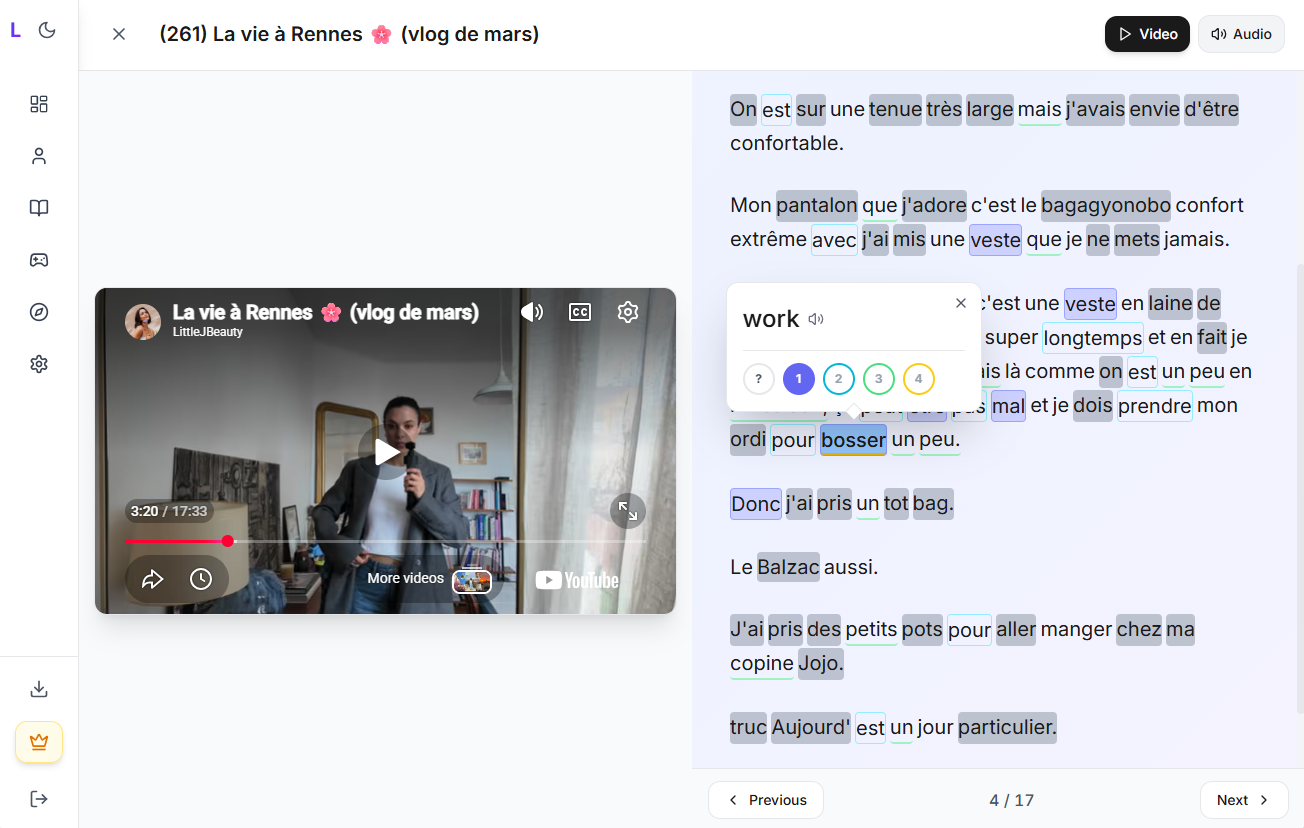
With Lokia, you can learn from videos, click subtitle words for instant meaning, save slang you notice, and review it later with flashcards. That makes it much easier to understand words like wesh, seum, or c’est carré when you hear them in real situations.
Instead of guessing slang, you learn it where it actually lives: in real content.