Korean Sentence Structure: Beginner’s Guide
Learn Korean sentence structure with simple examples. Understand SOV word order, particles, adjectives, questions, and how to build natural Korean sentences.
Korean sentence structure is one of the first things you need to understand if you want to make natural Korean sentences instead of translating directly from English.
The biggest difference is simple: English usually puts the verb in the middle of the sentence, while Korean usually puts the verb at the end.
Once you understand this rhythm, Korean becomes much easier to read, hear, and speak. You start to notice where the subject goes, where the object goes, why particles are useful, and why the final verb matters so much.
This guide explains the most important Korean sentence patterns with pronunciation, literal meaning, and natural English translations.
The basic Korean sentence structure
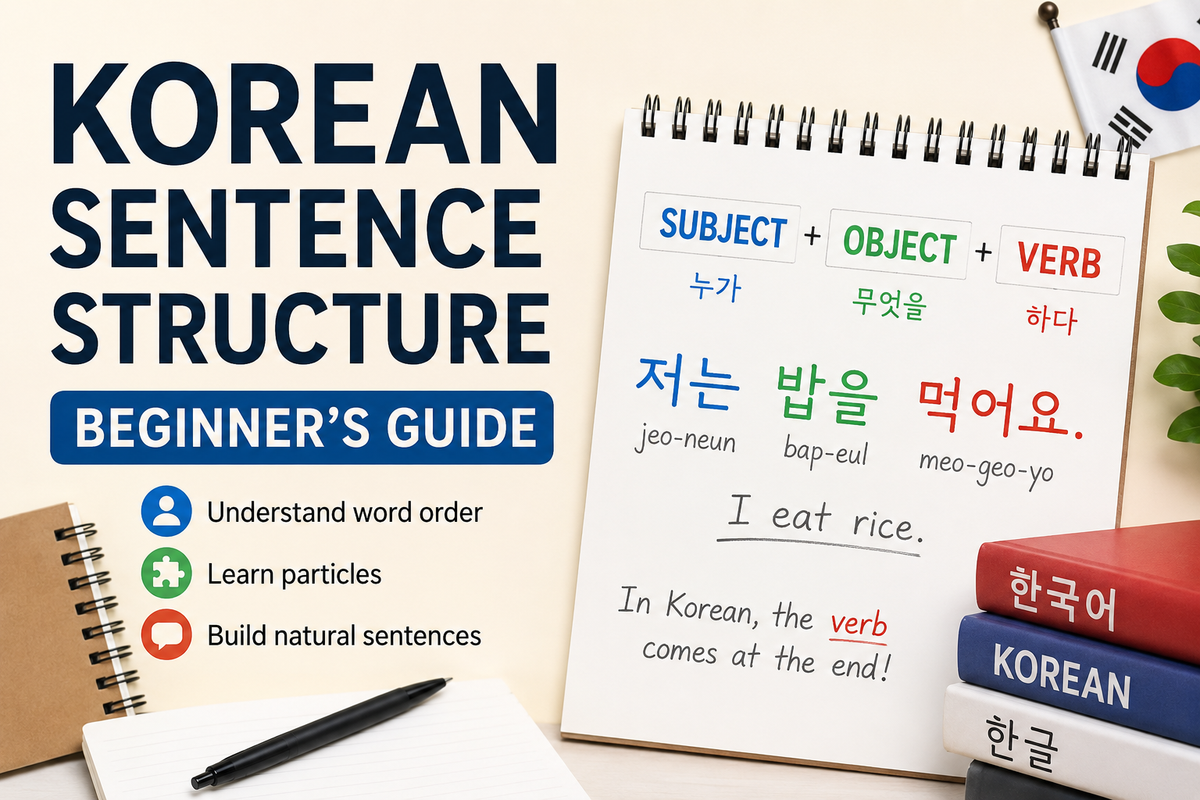
The basic Korean sentence structure is:
Subject + Object + Verb
English usually follows a different order:
Subject + Verb + Object
Here is a simple example:
| Korean | Pronunciation | Meaning | Role |
|---|---|---|---|
| 저는 | jeo-neun | I / as for me | Subject or topic |
| 밥을 | bap-eul | rice | Object |
| 먹어요 | meo-geo-yo | eat | Verb |
Why the verb comes last in Korean
In Korean, the final verb gives you the action and often the tense, politeness level, and sentence mood. That is why the end of the sentence is so important.
The subject is not written here. Korean does not always need it when the context is clear.
The same Korean sentence can sometimes be a statement or a question. In speech, intonation often tells you which one it is.
Common Korean sentence patterns
You do not need to learn every possible Korean structure at once. Start with a few common patterns and reuse them until they feel automatic.
Subject + Verb
Use this pattern when there is no object.
Subject + Object + Verb
This is the pattern beginners should practice the most.
The Korean rhythm is closer to:
Who + What + Does
That is why “I drink coffee” becomes “I coffee drink” in Korean order.
Subject + Noun + 이에요 / 예요
Use this structure when you want to say that someone or something is a noun.
Use 이에요 after a noun ending in a consonant, and 예요 after a noun ending in a vowel.
How Korean particles work
Korean particles are small grammar markers attached to nouns. They show the role of a word in the sentence.
English depends heavily on word order. Korean uses word order too, but particles make the sentence clearer.
은 / 는: topic markers
Use 은 after a consonant and 는 after a vowel. These particles often mean “as for...” or “speaking of...”
이 / 가: subject markers
Use 이 after a consonant and 가 after a vowel. These particles point to the subject more directly.
을 / 를: object markers
Use 을 after a consonant and 를 after a vowel. These particles mark the object of the sentence.
Where time and place go
Time and place usually come before the main verb. A useful beginner pattern is:
Time + Place + Subject + Object + Verb
In real Korean, the order can change depending on emphasis, but this pattern is easy to use when you are starting out.
| Part | Example | Pronunciation | Meaning |
|---|---|---|---|
| Time | 오늘 | o-neul | today |
| Place | 집에서 | jib-e-seo | at home |
| Object | 한국어를 | han-gu-geo-reul | Korean |
| Verb | 공부해요 | gong-bu-hae-yo | study |
How Korean adjectives work
Korean adjectives are different from English adjectives. In English, you need “is” in sentences like “the food is delicious.” In Korean, the adjective already works more like a descriptive verb.
The pattern is:
Subject + Adjective
You do not need to insert the English word “is” into the Korean sentence.
How to make questions in Korean
In everyday polite Korean, you can often make a question without changing the word order. You change the intonation when speaking, or add a question mark when writing.
Korean question words
| Korean | Pronunciation | Meaning |
|---|---|---|
| 누구 | nu-gu | who |
| 뭐 / 무엇 | mwo / mu-eot | what |
| 어디 | eo-di | where |
| 언제 | eon-je | when |
| 왜 | wae | why |
| 어떻게 | eo-tteo-ke | how |
In Korean, the question word often stays where the missing information would normally appear.
Why Korean often drops the subject
Korean speakers often leave out the subject when everyone already knows who or what they are talking about.
If the subject is already clear, you may hear a shorter version.
In a very clear context, the verb alone can be enough.
This is one reason beginner Korean can sound unnatural. Learners often repeat 저는 because English needs “I,” but Korean does not always need it.
Common beginner mistakes
Putting the verb too early
The most common mistake is using English word order inside a Korean sentence.
Translating “is” too literally
Do not insert the English word “is” into Korean adjective sentences.
Repeating 저는 too much
저는 is useful, but repeating it in every sentence can sound heavy.
Ignoring particles completely
Native speakers sometimes drop particles in casual speech, but beginners should learn them properly. Particles help you understand who does what in the sentence.
How to practice Korean sentence structure
A good way to practice is to build sentences from the verb outward. This helps you stop thinking in English order.
This works even better when you see the same patterns again and again in real context, which is the idea behind comprehensible input.
You can use the same method with many verbs: start with the verb, add the object, add the subject, then add time and place.
Simple patterns to memorize
The Korean way to build sentences
Korean sentence structure becomes much easier when you stop forcing English order onto Korean.
Keep the verb at the end, use particles to understand each word’s role, and do not worry if Korean leaves out the subject when the context is clear.
Once that pattern feels natural, you will be able to build clearer sentences and understand Korean grammar with much less effort.