Korean Particles: Beginner’s Guide
Learn Korean particles with simple examples. Understand 은/는, 이/가, 을/를, 에, 에서 and more to build clearer Korean sentences.
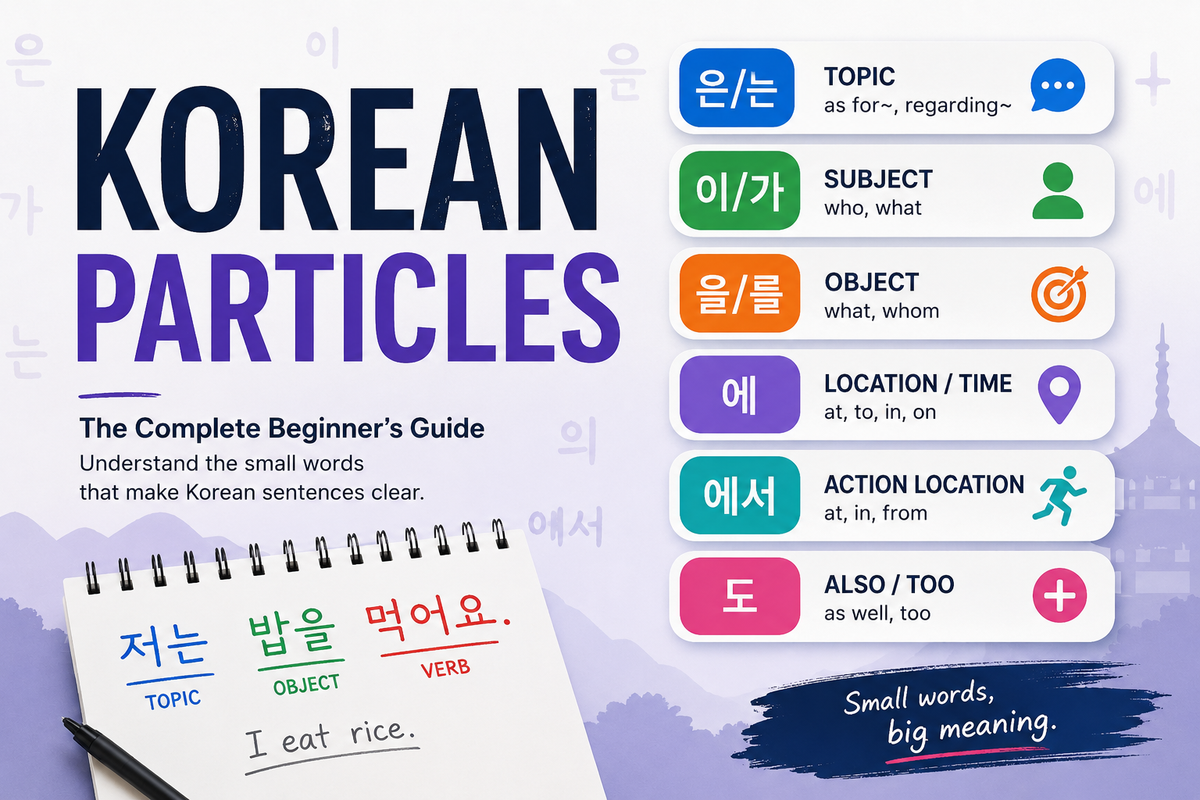
Korean particles are small grammar markers that attach to words and show their role in a sentence. They can tell you who is doing the action, what receives the action, where something happens, where someone is going, or what the sentence is mainly about.
If Korean sentence structure feels confusing, particles are often the missing piece. English relies heavily on word order, but Korean uses both word order and particles to make meaning clear.
In this sentence, 는 marks the topic, 을 marks the object, and 먹어요 is the verb. Once you understand that logic, Korean becomes much easier to read and build.
Korean particles at a glance
Here is a quick overview of the most useful Korean particles for beginners. You do not need to memorize all of them at once, but this table will help you recognize them when they appear in sentences.
| Particle | Main use | Simple example | Meaning |
|---|---|---|---|
| 은 / 는 | Topic | 저는 학생이에요. | I am a student. |
| 이 / 가 | Subject | 비가 와요. | It is raining. |
| 을 / 를 | Object | 밥을 먹어요. | I eat rice. |
| 에 | Destination, time, existence | 학교에 가요. | I go to school. |
| 에서 | Action location | 카페에서 공부해요. | I study at a cafe. |
| 도 | Also / too | 저도 가요. | I am going too. |
| 만 | Only | 물만 마셔요. | I only drink water. |
| 의 | Possession | 저의 책이에요. | It is my book. |
If you want to understand the bigger sentence pattern first, read our guide to Korean sentence structure. This article focuses specifically on particles.
What are Korean particles?
Korean particles are short grammar pieces attached directly to nouns. They do not usually translate neatly into English, but they show how a word works inside the sentence.
For example, English says:
Korean says:
The sentence order is different, but the particles help you see the structure. 는 tells us that 저 is the topic. 을 tells us that 밥 is the object.
은 / 는: topic particles
은 and 는 mark the topic of the sentence. The topic is what the sentence is mainly about.
Use 은 after a consonant. Use 는 after a vowel.
Topic particles are useful when you introduce a subject, compare things, or shift attention to something new.
Here, 는 helps create contrast between coffee and tea.
이 / 가: subject particles
이 and 가 mark the subject of the sentence. The subject is the person, thing, or idea doing the action or being described.
Use 이 after a consonant. Use 가 after a vowel.
The difference between 은 / 는 and 이 / 가 is one of the most confusing topics for beginners. You do not need to master every nuance right away.
제가 gives more focus to “I” than 저는 would in this sentence.
을 / 를: object particles
을 and 를 mark the object of a sentence. The object is the thing that receives the action.
Use 을 after a consonant. Use 를 after a vowel.
If a word answers “what?” after the verb, it is often the object.
To see these particles inside complete everyday sentences, you can also read our guide to basic Korean sentences.
에 and 에서: location particles
에 and 에서 both relate to place, but they are not the same.
Use 에 for destination, existence, or time. Use 에서 for the place where an action happens.
에 for destination
에 for existence
에 for time
에서 for action location
도, 만, 의: also, only, and possession
도 means also or too
만 means only
의 shows possession
In natural speech, 저의 often becomes 제.
와 / 과, 하고, 이랑 / 랑: and or with
Korean has several ways to say “and” or “with.” The best choice depends on how formal or casual you want to sound.
와 / 과
와 and 과 are often used in writing or more formal Korean. Use 와 after a vowel and 과 after a consonant.
하고
하고 is common in everyday speech.
이랑 / 랑
이랑 and 랑 are casual and very common in conversation. Use 이랑 after a consonant and 랑 after a vowel.
에게, 한테, 께: to someone
에게, 한테, and 께 can mean “to someone.” They are often used with verbs like give, tell, send, or teach.
한테 is common in speech. 에게 is a little more written or neutral. 께 is honorific and shows respect.
으로 / 로: direction, method, and tool
으로 and 로 can show direction, method, tool, material, or means of transportation.
Use 으로 after most consonants. Use 로 after a vowel or after the consonant ㄹ.
부터, 까지, 보다: from, until, and than
부터 means from or starting from
까지 means until or up to
보다 means than
처럼 and 같이: like or as
처럼 and 같이 can both mean “like” or “as.” They are useful when you compare one person or thing to another.
Grammar is easier to remember when you keep seeing it in real situations. That is why comprehensible input is useful: you learn patterns through context, not just isolated rules.
Common mistakes with Korean particles
Using 은 / 는 and 이 / 가 randomly
Beginners often use topic and subject particles as if they are interchangeable. They are related, but they do not feel the same.
The difference is subtle, but important. 저는 feels more like introducing information about yourself. 제가 puts stronger focus on “I.”
Confusing 에 and 에서
Use 에 when you go to a place or when something exists somewhere. Use 에서 when an action happens in a place.
Dropping particles too early
Native speakers often drop particles in casual speech, but beginners should not ignore them. If you learn the particles first, you will understand Korean sentences much more clearly.
How to practice Korean particles
The best way to practice particles is not to memorize a huge list at once. Start with the particles that appear in basic sentences, then add more as you see them in real content.
You can also learn a language with Lokia by saving useful words and sentences from real videos, then reviewing them with spaced repetition and mini-games.
Korean particles become easier with context
Korean particles may feel difficult at first because English does not use grammar markers in the same way. But the idea behind them is simple: particles show the role of each word.
Start with the most common particles, practice them inside full sentences, and pay attention to how they appear in real Korean content.
If you are wondering how this fits into a full learning routine, our guide on how long it takes to learn a language gives a realistic view of progress over time.
The goal is not to memorize every particle perfectly in one day. The goal is to recognize them again and again until Korean sentences start to feel clear.