Hangul Alphabet: Learn the Korean Alphabet
Learn the Hangul alphabet with a colorful Korean alphabet chart, pronunciation tips, syllable blocks, and easy example words for beginners.
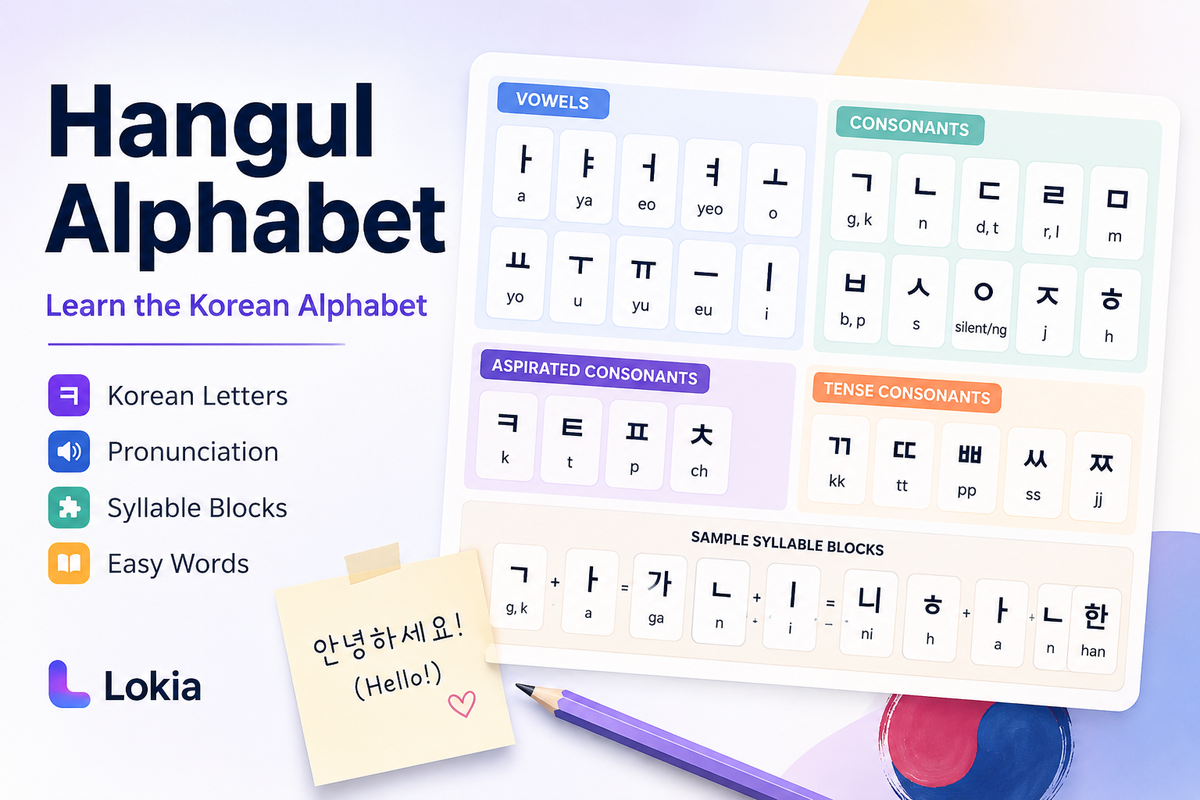
The Hangul alphabet is the Korean writing system. It may look difficult at first, but it is one of the most logical alphabets you can learn. Once you understand how the letters combine, you can start reading Korean words much faster than you might expect.
This guide will show you the essential Korean vowels, consonants, pronunciation patterns, and syllable blocks. You will also see simple Korean words with audio buttons so you can connect each Hangul letter with a real sound.
Hangul alphabet chart
Hangul is built from consonants and vowels. Instead of writing letters in a straight line like English, Korean groups them into syllable blocks. For example, ㄱ plus ㅏ becomes 가, pronounced ga.
Basic vowels
Basic consonants
Aspirated consonants
Tense consonants
You do not need to memorize everything perfectly before reading. Start with the basic vowels and consonants, then practice simple blocks like 가, 나, 고, and 무.
Korean vowels
Every Korean syllable needs a vowel. The six vowels below are the best place to start because they appear constantly in beginner Korean words.
ㅏ sounds like a clear “ah”. In 아, the letter ㅇ is silent, so you only hear the vowel.
ㅓ is a deeper “uh” sound. It is written eo in romanization, but it is one Korean vowel.
ㅗ is a rounded “o” sound. You hear it in 오늘, meaning today.
ㅜ sounds like “oo” in food. You hear it in 우리, meaning we or our.
ㅡ is a flat vowel with relaxed lips. It is one of the hardest Hangul sounds for English speakers.
ㅣ sounds like “ee” in see. You hear it in 이름, meaning name.
The most important tip is to avoid reading romanization as English. eo and eu are not English spellings. They are just rough labels for Korean sounds.
Korean consonants
Korean consonants can change slightly depending on where they appear in a word. For beginners, focus first on the most common sound and one simple example.
ㄱ can sound close to g or k. In 가, it is pronounced ga.
ㄴ sounds like n. In 나, it is pronounced na and means I or me.
ㄷ can sound close to d or t. In 다, it is pronounced da.
ㄹ sits between an r and l sound. In 라면, it starts the word ra-myeon.
ㅁ sounds like m. In 머리, it starts the word for head or hair.
ㅂ can sound close to b or p. In 바다, it starts the word for sea.
ㅅ usually sounds like s. In 사람, it starts the word for person.
ㅇ is silent at the start of a syllable, as in 아. At the end, it sounds like ng, as in 강.
Some Korean letters have no perfect English equivalent. That is normal. Hangul pronunciation becomes much clearer when you read and listen at the same time.
How Hangul syllable blocks work
Hangul letters are grouped into square blocks. Each block usually represents one syllable. The block changes shape depending on the vowel.
Consonant plus vertical vowel
With a vertical vowel like ㅏ, the vowel goes on the right side.
Consonant plus horizontal vowel
With a horizontal vowel like ㅗ or ㅜ, the vowel goes below the consonant.
Adding a final consonant
A final consonant goes at the bottom of the block. This final position is called batchim.
How to read a Korean sentence
Now let’s break down a short Korean sentence. The goal is not to understand every grammar detail yet. The goal is to see how each written block connects to pronunciation.
Example sentence
Read it slowly first: jeo-neun han-gu-geo-reul gong-bu-hae-yo. Then play the audio and match each Korean block to the sound you hear.
If sentence structure still feels confusing after learning Hangul, continue with this guide to Korean sentence structure. It explains how Korean word order works after you can read the alphabet.
Easy Korean words to practice
Try reading each word before clicking the audio button. Once you feel comfortable with these examples, a Korean alphabet quiz can help you check which letters you recognize instantly and which ones still need practice.
na, I or me
neo, you
u-ri, we or our
han-guk, Korea
han-gu-geo, Korean language
sa-ram, person
sa-rang, love
hak-gyo, school
chin-gu, friend
Hangul alphabet recap
Before moving on, use this recap table to review the full Hangul alphabet in one place. It brings together the basic vowels, compound vowels, consonants, tense consonants, and pronunciation hints so you can quickly check any letter while practicing.
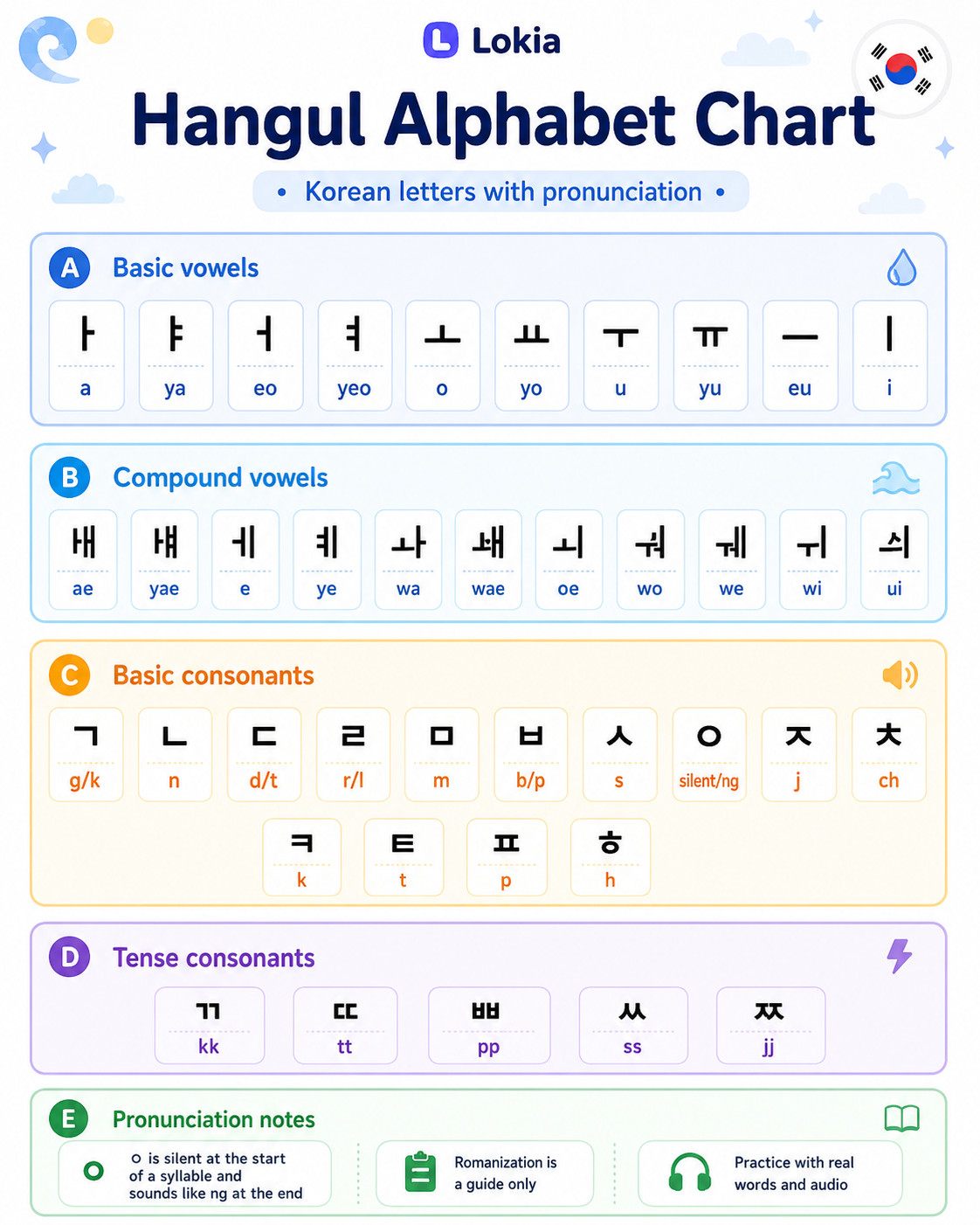
You can come back to this chart whenever you practice Korean words, review a Korean alphabet quiz, or read subtitles in real Korean content.
What to learn next
Once you can read the Hangul alphabet, move into simple words, particles, and short sentences. A good next step is learning how particles such as 은, 는, 이, and 가 work in real Korean sentences. You can start with this beginner guide to Korean particles.
You should also practice with real Korean audio as soon as possible. Reading Hangul is useful, but the alphabet becomes much easier to remember when you connect each word with the way native speakers actually say it.
With Lokia, you can learn Korean from real videos and subtitles. Click Korean words, understand them in context, save useful vocabulary, and review it later. That helps you stop depending on romanization and start recognizing Hangul directly in real Korean content.